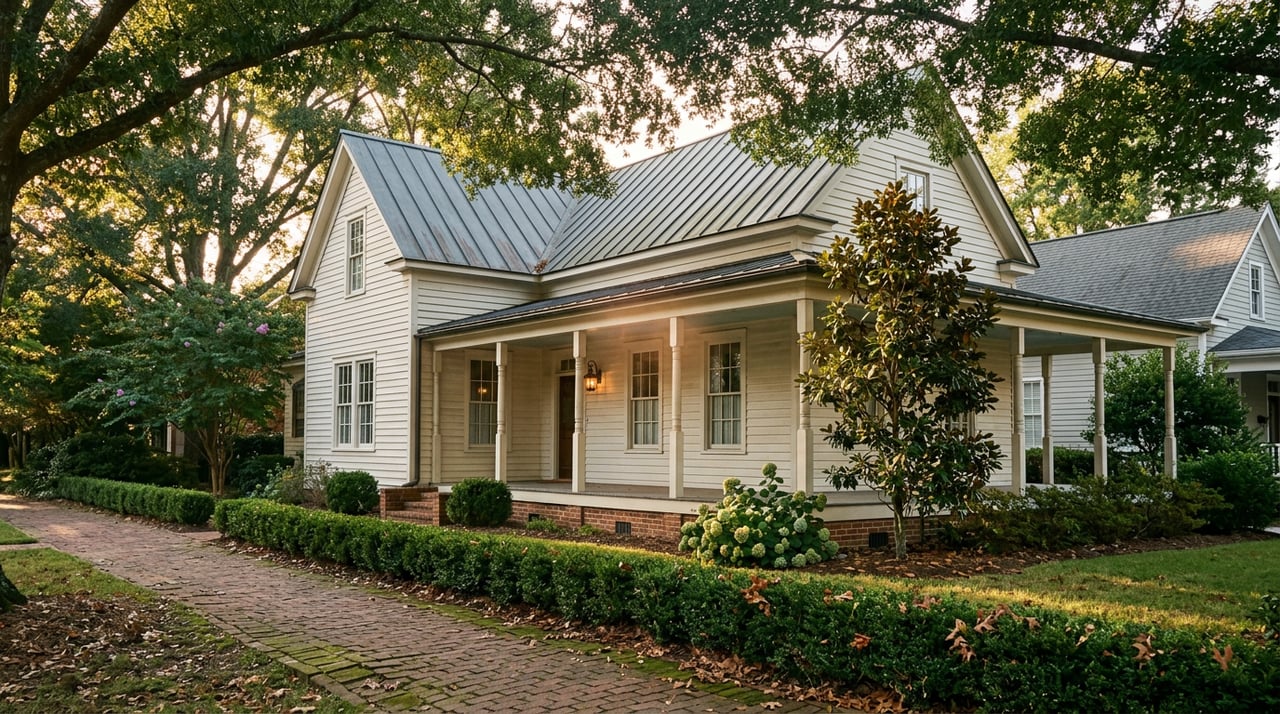
Walk south on Main Street from the Davidson College gates past the Soda Shop, and the sidewalk changes under your feet before anything else does. Brick, laid decades ago, runs the length of the historic core, and the oaks along it have grown tall enough now to close into a single canopy overhead. It's the kind of thing you stop noticing once you live here, the reason a five-minute errand to Summit Coffee or Main Street Books feels unhurried even in August.
This fall, that canopy earned a credential most people walking under it will never see: the Town of Davidson has been awarded Level 1 Accreditation by ArbNet, the international arboretum accreditation program, in partnership with The Morton Arboretum, for meeting the kind of professional management standards usually applied to botanic gardens and university arboreta.
That's an odd thing for a town to receive. Parks get named. Trails get ribbon cuttings. Arboretum accreditation is a different animal, and the reason Davidson qualified says more about two decades of quiet town policy than it does about any single tree on Main Street.
What the Accreditation Actually Checks For
ArbNet doesn't hand out its credential for having attractive trees. It exists to certify that a collection, whether it belongs to a university, a public garden, or in this case a town, is managed like one: publicly accessible, professionally overseen, and backed by a written plan for what happens to it going forward. Judged against that bar, the fact that Davidson qualified at all means somebody has been tracking what happens to Main Street's trees the way a curator tracks a collection, not the way a public works crew tracks a maintenance backlog.
That distinction matters because it points to a paper trail, and Davidson has had one running for a long time.
The Paper Trail Existed Before the Plaque
Davidson's historic core sits inside a National Historic District covering 580 properties centered on Main Street, a designation the state approved specifically to protect the town's mix of Greek Revival, Queen Anne, Colonial Revival, Tudor Revival, and Craftsman-era buildings. Anyone doing exterior work inside that district, including work that touches a yard or a street-facing lot, needs a Certificate of Appropriateness before they start. That review process is precisely the kind of documentation an arboretum accreditation depends on: a record of what's allowed to change on Main Street and what isn't, kept building by building and, it turns out, tree by tree, well before ArbNet ever looked at Davidson's application.
The town's own planning work makes the connection explicit rather than incidental. Davidson Design for Life, the town's long-running health and mobility initiative, commissioned an assessment of the town's street design standards specifically to examine how street layout affects physical activity and air quality, including how much driving a resident has to do just to run errands. A canopy that shades a walkable sidewalk isn't a side effect of that goal. It's the mechanism.
This fall, the same instinct showed up in a smaller, more immediate form. Beginning Monday, August 3, 2026, NCDOT installed temporary three-way stop signs at Potts Street and Catawba Avenue and at South Main Street and Catawba Avenue, the kind of traffic control a town typically adds while it tests whether an intersection needs something more permanent. It's a small move, but it sits inside the same historic core the arboretum designation covers, and it fits the same pattern: protect the walk before you protect the view.
The Business Side of the Same Standard
The town isn't only spending on infrastructure this fall. The Davidson Main Street Business Grant program opened its thirteenth year of applications on September 1, 2026, with a first window running through October 31 and rolling 90-day cycles after that until the fund runs out. The Board of Commissioners approved $15,000 for Fiscal Year 2027, distributed as matching grants: businesses have to commit two private dollars for every public dollar they receive, with individual awards ranging from $1,000 to $10,000, and the money has to go toward permanent exterior or interior improvements.
Here's the part that ties back to the trees. Because most of that grant money lands inside the same historic district, any storefront owner using it for exterior work, including anything that touches the street frontage, still has to clear the same Certificate of Appropriateness review that governs the canopy. The business grant and the arboretum accreditation are functioning off the identical oversight system. Nobody on Main Street gets to make a unilateral call about what the street looks like, whether they're a homeowner, a shop owner, or the town itself.
A short snapshot of what's moved this fall:
| What | When | Detail |
|---|---|---|
| NCDOT intersection change | Aug. 3, 2026 | Temporary 3-way stops at Potts/Catawba and Main/Catawba |
| Main Street Business Grant, 13th round | Sept. 1 – Oct. 31, 2026 | $15,000 approved for FY2027, 2:1 private match, awards $1,000–$10,000 |
| National Night Out Davidson | Oct. 6, 2026 | Free evening event connecting residents with local businesses |
None of these three things needed the others to happen. Read together, they describe a town that keeps making the same call on a rolling basis rather than a town that got lucky with old trees.
Where the Canopy Actually Shows Up
If you want to feel what the accreditation represents rather than just read about it, Davidson's own calendar routes you through the canopy on a regular basis. April is for Arts turns the sidewalks into a walking gallery during the Main Street Gallery Crawl, paired with Art on the Green on the town's central lawn. The weekly farmers market sets up under the same trees that just got formally inventoried. Christmas in Davidson pulls more than 30,000 people onto Main Street over three days each December, closing with the North Mecklenburg Christmas Parade, a 30-year tradition that a bare, treeless street couldn't support in quite the same way. And the Green Day Sustainability Festival each spring is the one event that explicitly celebrates the town's environmental management, which is presumably the file that impressed ArbNet's reviewers in the first place.
That's a different rhythm than the five packed football Saturdays that flip Main Street's normal quiet on its head every fall. The canopy is the constant underneath both versions of the town, the crowded one and the quiet one.
The Plaque Is a Receipt, Not a Reveal
None of this means Davidson suddenly became more walkable this year. It means an outside reviewer looked at two decades of historic district oversight, a health-focused street design assessment, a rolling business grant program, and a habit of adjusting intersections before they become a problem, and concluded that the trees along the way are being managed as carefully as everything else on the list. The accreditation didn't create that pattern. It just gave it a name.
If you're weighing what daily life on this stretch of Lake Norman actually looks like, beyond the accreditation, we've also mapped out what a weekend in Davidson tends to involve, and our Davidson neighborhood guide covers the rest of the town beyond Main Street.
At Southern Charm Realty & Retreats, we spend as much time paying attention to a town's sidewalks and street trees as we do its listings, because the two are rarely unrelated. If you're curious what a specific block, cove, or corner of Davidson actually lives like day to day, schedule a Lake Norman consult, by car or by boat.